Key takeaways
- A fully funded master's scholarship usually covers tuition, a living stipend, and often travel, but every funder defines it differently.
- Most master's funding comes from competitive scholarships you apply for, often separately from your university application.
- Funding comes from three main sources: universities, governments, and foundations.
- Check eligibility before you write a word. Nationality, experience, and post-study commitments rule out most mismatches.
- Five well-matched applications beat twenty generic ones.
What's better than one degree? Two! Well, to be fair, it could be three, but go easy, tiger. Let's crawl before we fly. The natural progression after a bachelor's is to get a master's. If you school in Nigeria, the holy grail is to get your master's degree abroad. The reasons are numerous, but let's just limit it to wanting a new experience.
For the average person, financing a master's degree on your own is impossible. Tuition, rent, flights, and miscellaneous costs are so high. The good news is that thousands of students study abroad each year without paying tuition, on fully funded master's scholarships.
The catch? These awards are competitive, and the information is scattered. This guide shows you everything you need to know about getting fully funded master's scholarships. If you're weighing a PhD as well, our guide to fully funded graduate scholarships covers both routes and how they differ.
What is a fully funded master's scholarship?
A fully funded master's scholarship covers the main costs of a one- or two-year master's degree. It typically includes:
- Tuition fees: full tuition at the international rate.
- Living stipend: monthly payments for rent, food, and groceries.
- Travel: often an economy flight at the start and end of your course.
- Visa and health costs: some awards cover visa fees and health surcharges.
- Extra allowances: possible settling-in or study travel grants.
Types of master's funding
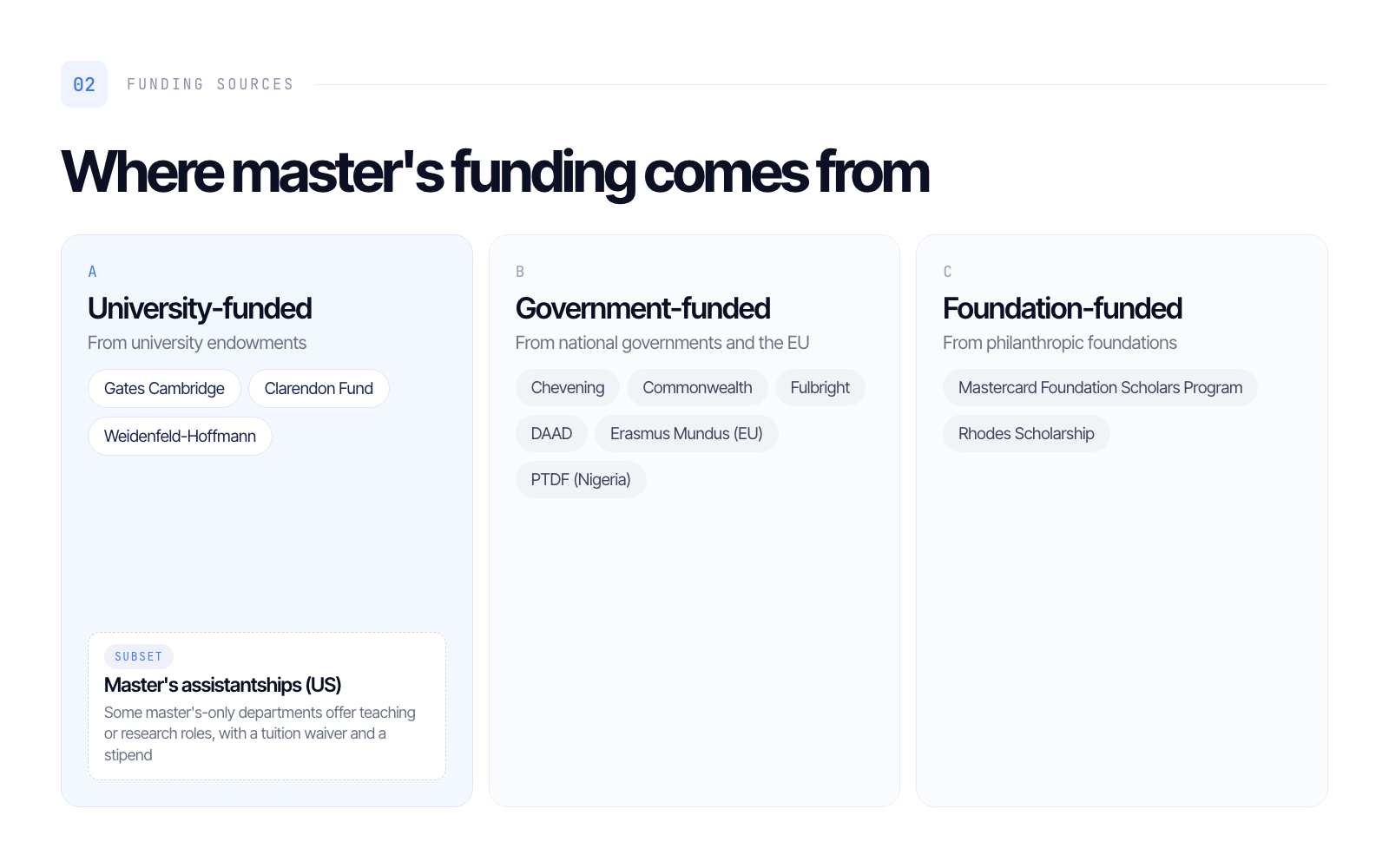
Master's funding comes from three major sources:
University-funded
Universities fund these from their own endowments to attract top international students.
- Gates Cambridge (UK): awards for master's courses such as the MPhil, MRes and LLM at Cambridge, open to any non-UK citizen.
- Clarendon Fund (UK): Oxford scholarships you're considered for automatically when you apply by your course's deadline.
- Weidenfeld-Hoffmann Scholarships (UK): fully funded Oxford study plus a leadership program, mainly for applicants from low- and middle-income countries.
- Master's assistantships: in the U.S., some departments that offer only a master's give teaching or research assistantships to master's students, which come with a tuition waiver and a stipend.
Government-funded
Governments fund these to build international ties and skills.
- Chevening (UK): a one-year UK master's for future leaders with at least two years of work experience.
- Fulbright Foreign Student Program (US): graduate study in the US, run through each country's Fulbright commission or US embassy.
- Erasmus Mundus Joint Master's (EU): EU-funded master's programs taught across at least two European countries.
- PTDF (Nigeria): Nigerian government funding through in-country and overseas schemes.
Foundation-funded
Philanthropic foundations fund these, often with a regional or social-impact focus.
- Mastercard Foundation Scholars Program: master's scholarships for young people, mainly from Africa, at partner universities.
- Rhodes Scholarship: postgraduate study at Oxford for exceptional all-rounders, selected by constituency.
Top fully funded master's scholarships
This is a list of some top fully funded master's scholarships:
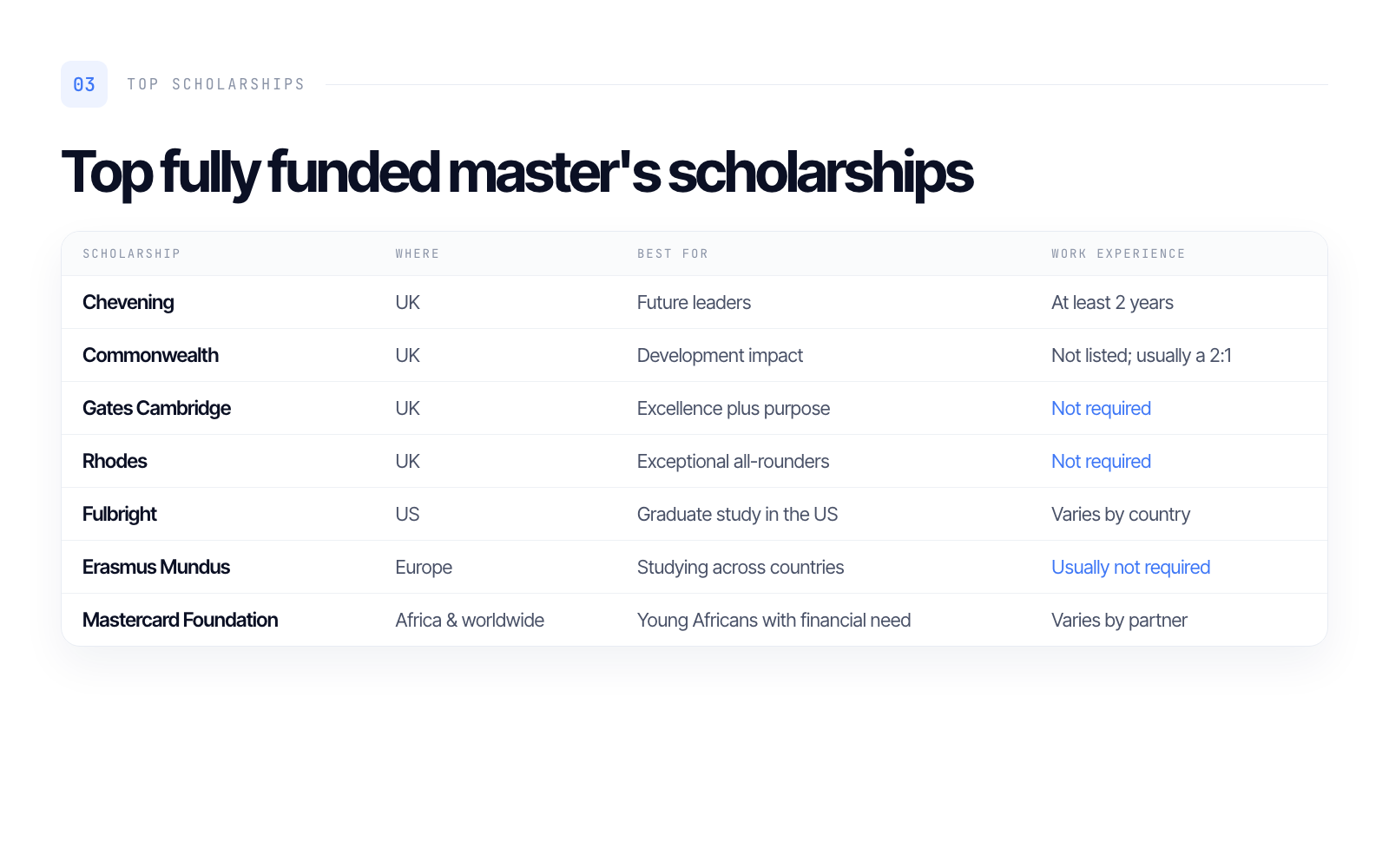
| Scholarship | Where | Best for | Work experience |
|---|---|---|---|
| Chevening | UK | Future leaders | At least 2 years |
| Commonwealth | UK | Development impact | Not listed; usually a 2:1 degree |
| Rhodes | UK | Exceptional all-rounders | Not required |
| Fulbright | US | Graduate study in the US | Varies by country |
| Erasmus Mundus | Europe | Studying across countries | Usually not required |
| Mastercard Foundation | Africa and worldwide | Young Africans with financial need | Varies by partner |
How to find fully funded master's programs
Here are some ways you can find fully funded master's programs:
- Official funder websites: sign up for alerts from the programs above.
- University funding pages: search "[university] international master's scholarships." Many universities run their own awards.
- The Erasmus Mundus Catalogue: the official list of current EU-funded joint master's programs.
- Databases: ProFellow lists fully funded master's programs (free account required).
- GradPath: matches funding to your degree, field, nationality, and destination, with links to the official source.
Then run four quick eligibility checks:
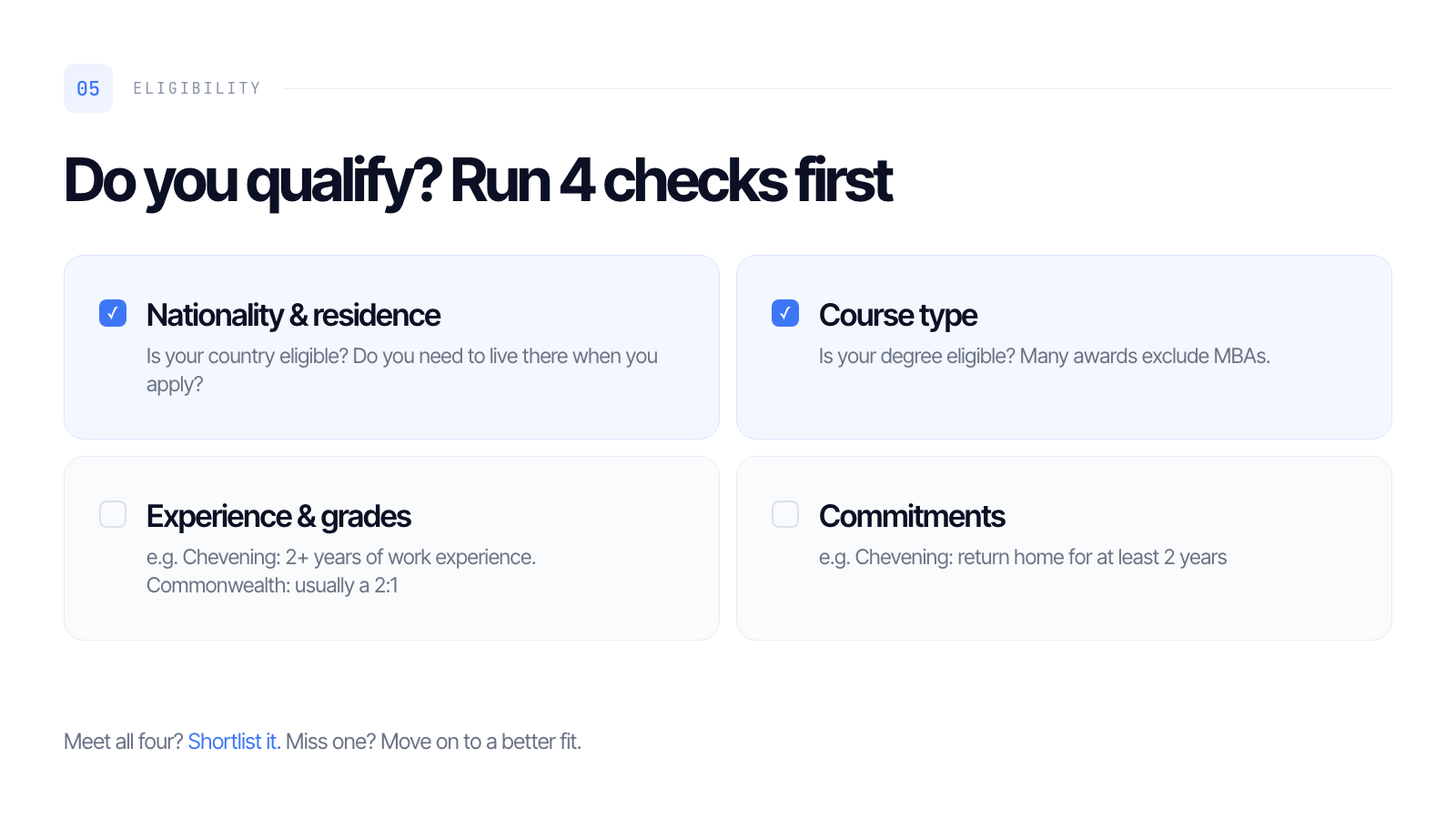
- Nationality and residence Is your country eligible? Do you need to live there when you apply?
- Course type Is your degree eligible? Many awards exclude MBAs.
- Experience and grades For example, Chevening asks for two years of work experience, and Commonwealth usually expects a 2:1.
- Commitments For example, Chevening requires you to return home for at least two years.
How to win a fully funded master's scholarship
Match the scholarship to your story
Each funder looks for something different. Chevening wants leadership, Commonwealth wants development impact, and Gates Cambridge wants academic excellence plus commitment to improving others' lives. Apply where your experience fits.
Get your admission timing right
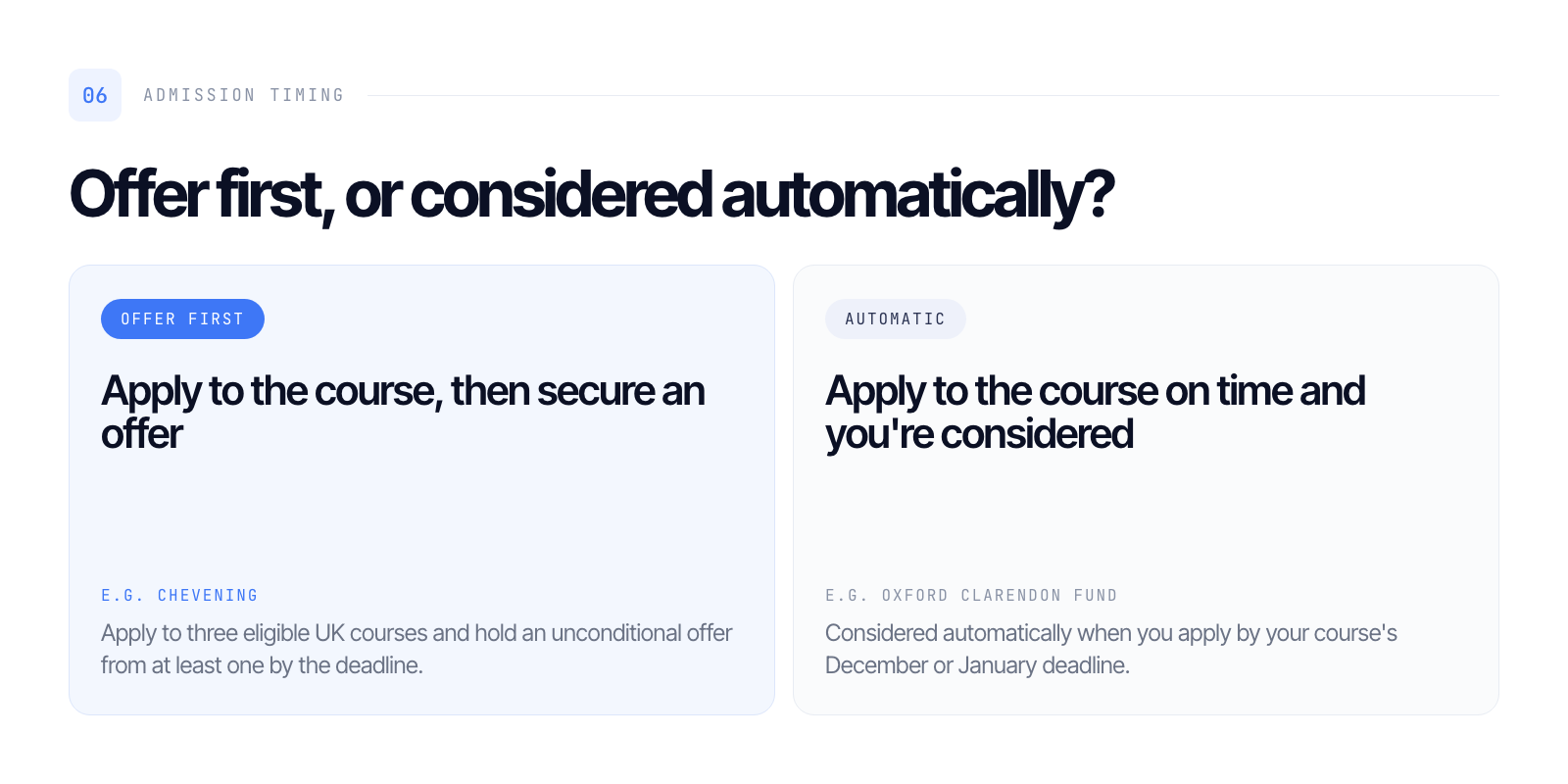
Some scholarships need an offer first. Chevening, for example, asks you to apply to three eligible UK courses and hold an unconditional offer from at least one by its deadline. Others, like Oxford's Clarendon Fund, consider you automatically when you apply for the course by the funding deadline.
Write a specific statement of purpose
Show who you are with specific stories, clear goals, and evidence. Avoid clichés like "Since childhood, I have always been passionate about…"
Secure strong references
Ask 2–3 referees who know your work well, at least 3–4 weeks ahead. Send them your CV and draft statement.
Apply strategically and track deadlines
Shortlist 5–8 strong fits, start about 12 months before your course begins, and set your own deadline a week before each official one. Some scholarships have more than one deadline (see how to read a scholarship deadline).
Your fully funded master's starts with the right list. Find it on GradPath. It's free to start.
FAQs
Can international students get fully funded master's scholarships?
Yes. Chevening, Gates Cambridge, Rhodes, Fulbright and Erasmus Mundus all fund international master's students, subject to their eligibility rules.
Do I need work experience for a fully funded master's?
Some awards require it (Chevening asks for at least two years). Many university scholarships and Erasmus Mundus programs don't.
How many scholarships should I apply for?
Most applicants do well with 5–8 carefully matched applications.
Do I need to pay anyone to apply?
No. Legitimate scholarships don't charge application fees. Universities may charge an admission fee, but never pay a third party to "secure" a scholarship.